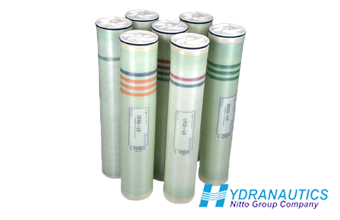
HYDRANAUTICS RO MEMBRANES
Key Features
| HYDRANAUTICS RO MEMBRANES | : | Product Name Hydranautics RO Membranes Brand Hydranautics (A Nitto Group Company) Membrane Type Thin-Film Composite (TFC) Polyamide Configuration Spiral-Wound Element Application Brackish Water, Seawater, Wastewater Reuse, Industrial Process Water Salt Rejection Rate Up to 99.7% (depending on model) Permeate Flow Rate 2,000 – 12,000 GPD (varies by model) Operating Pressure 150 – 1,200 psi (10 – 82 bar) Maximum Feed Water Temperature 45°C (113°F) pH Range (Continuous Operation) 2 – 11 pH Range (Cleaning) 1 – 13 Maximum Feed Water Turbidity 1.0 NTU Maximum Feed Water SDI (15 min) < 5 Free Chlorine Tolerance < 0.1 ppm Recovery Rate Up to 85% (system dependent) Feed Spacer Thickness 28 – 34 mil Membrane Material Polyamide Composite Outer Shell Material FRP or PVC (depending on housing) Element Diameter 4” / 8” standard sizes Element Length 40” (standard) End Connection Type Standard Male/Female Interconnect Typical Applications Desalination, Drinking Water Systems, Industrial Filtration, Boiler Feed, Food & Beverage Processing Cleaning Frequency As required based on fouling (typically every 3–6 months) Design Life 3 – 7 years (depending on feed water quality and maintenance) Certifications NSF/ANSI Standard 58, ISO 9001 Country of Origin Japan / USA (depending on model) |
| View More Info | ||
Hydranautics
reverse osmosis (RO) membranes deliver industry-leading reliability, efficiency
and water quality for commercial, industrial and municipal desalination and
purification systems. Engineered from advanced thin-film composite materials
and precision-manufactured to exacting tolerances, Hydranautics membranes are
designed to remove dissolved salts, organics, bacteria and other contaminants
while maintaining high permeate flow and low energy consumption. Whether used
for brackish water treatment, seawater desalination, wastewater reuse or
ultrapure process water, Hydranautics offers a proven portfolio of elements to
match performance, footprint and lifecycle-cost goals.
Performance and technology
At
the heart of each Hydranautics membrane is a proprietary thin-film composite
active layer built for selective ion rejection and long-term chlorine
resistance. These membranes combine high salt rejection rates with excellent
flux stability across a wide range of feedwater qualities and operating
conditions. Hydranautics designs its elements for predictable, repeatable
performance — maximizing permeate recovery while minimizing fouling and energy
requirements. The result: operators achieve consistent product water quality
with fewer cleanings, lower chemical usage, and reduced downtime.
Product range and flexibility
Hydranautics
offers a comprehensive lineup of RO elements in standard industry housings and
sizes, making them easy to integrate into new systems or retrofits. Their
portfolio covers low-pressure brackish water membranes optimized for minimal
operating cost, high-rejection seawater elements for desalination, and
specialty elements for industrial applications such as boiler feedwater,
pharmaceutical process water and ultrapure semiconductor rinsing. Multiple
element diameters and lengths, plus a range of nominal salt rejection and flow
ratings, allow system designers to balance recovery, concentrate flow and
energy consumption to meet site-specific targets.
Operational advantages
Hydranauticsmembranes are engineered for operational resilience. They demonstrate strongtolerance to variable feed conditions and to common fouling species (colloids,
organics, biofoulants and scales) when operated within recommended limits and
with proper pretreatment. Low-pressure variants reduce required feed pressure,
lowering energy consumption and pump sizing. Many Hydranautics elements are
also designed to withstand standard cleaning regimes, enabling restoration of
performance after fouling events without damaging the membrane chemistry. The
predictable cleaning windows and longer intervals between replacements
translate directly into lower total cost of ownership.
Applications
HydranauticsRO membranes are widely used across sectors:
- Municipal and decentralized
water treatment for potable supply and seawater desalination
- Industrial process water for
power plants, food & beverage, chemical and textile industries
- High-purity water for
pharmaceuticals, laboratories and electronics manufacturing
- Wastewater reuse and
zero-liquid-discharge (ZLD) pre-concentration stages
- Commercial buildings and
hospitality for potable water and boiler feed systems
Ease of integration and service
Hydranauticselements are designed for drop-in compatibility with common element housingsand pressure vessels, simplifying upgrades and maintenance. Standardized brineseals, endcap designs and dimensional tolerances reduce installation time and
allow operators to keep common spare parts. The company’s technical documentation
includes detailed performance curves, pressure-drop charts and cleaning
protocols to help system engineers and operators optimize design and O&M
practices. In addition, Hydranautics supports customers with application
engineering, sizing guidance and troubleshooting assistance to ensure system
performance targets are met.
Durability and lifecycle considerations
Longevity
is a central design goal. Hydranautics membranes employ robust backing
materials and high-integrity bonding processes to resist compaction and
delamination over extended service periods. Proper pretreatment—such as
multimedia filtration, cartridge filtration, antiscalant dosing and pH
control—preserves membrane life and reduces irreversible fouling. When
maintained correctly, Hydranautics elements deliver consistent performance over
many months or years, reducing replacement frequency and lifecycle cost.
End-of-life replacement and element recycling programs may be available through
authorized distributors, helping minimize environmental impact.
Quality, compliance and certifications
Hydranautics
manufactures to strict quality control standards and typically offers product
documentation to support regulatory compliance and system certification
requirements. Technical datasheets provide validated salt rejection rates,
permeate flow at standard test conditions, and maximum operating limits for
temperature and pressure—information that simplifies system design, permitting
and regulatory reporting.
Why choose Hydranautics?
- Proven membrane chemistry
that balances high rejection with sustained flux
- Wide product selection for
brackish, seawater and specialty applications
- Predictable cleaning and
long service life that lower total cost of ownership
- Compatibility with standard
housings for easy retrofits and inventory management
- Strong technical support and
comprehensive product documentation
Recommended operating guidance (summary)
Toachieve optimal performance: implement effective pretreatment tailored to
feedwater characteristics; follow manufacturer cleaning and storage procedures;
monitor differential pressure and permeate quality to detect fouling early; and
size recovery and staging to prevent scaling. Routine monitoring and periodic
performance validation ensure the system continues to meet process and
regulatory requirements.
| HYDRANAUTICS RO MEMBRANES | Product Name Hydranautics RO Membranes Brand Hydranautics (A Nitto Group Company) Membrane Type Thin-Film Composite (TFC) Polyamide Configuration Spiral-Wound Element Application Brackish Water, Seawater, Wastewater Reuse, Industrial Process Water Salt Rejection Rate Up to 99.7% (depending on model) Permeate Flow Rate 2,000 – 12,000 GPD (varies by model) Operating Pressure 150 – 1,200 psi (10 – 82 bar) Maximum Feed Water Temperature 45°C (113°F) pH Range (Continuous Operation) 2 – 11 pH Range (Cleaning) 1 – 13 Maximum Feed Water Turbidity 1.0 NTU Maximum Feed Water SDI (15 min) < 5 Free Chlorine Tolerance < 0.1 ppm Recovery Rate Up to 85% (system dependent) Feed Spacer Thickness 28 – 34 mil Membrane Material Polyamide Composite Outer Shell Material FRP or PVC (depending on housing) Element Diameter 4” / 8” standard sizes Element Length 40” (standard) End Connection Type Standard Male/Female Interconnect Typical Applications Desalination, Drinking Water Systems, Industrial Filtration, Boiler Feed, Food & Beverage Processing Cleaning Frequency As required based on fouling (typically every 3–6 months) Design Life 3 – 7 years (depending on feed water quality and maintenance) Certifications NSF/ANSI Standard 58, ISO 9001 Country of Origin Japan / USA (depending on model) |
|---|
(0)
Login To Leave Review
Related Products
EMI Details
T&C