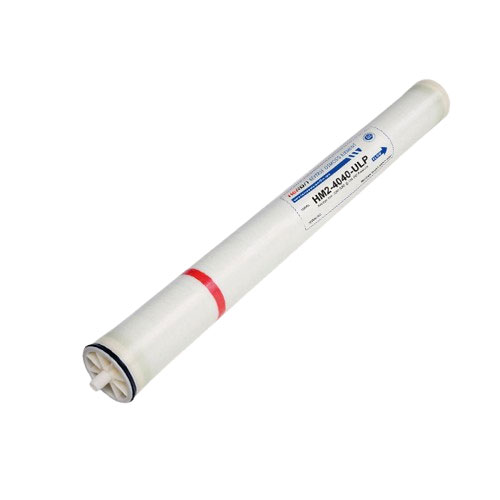
Heron Industrial Membrane HM2-4040-ULP
The Heron Industrial Membrane HM2-4040-ULP is a high-performance
reverse osmosis (RO) membrane element designed for industrial and commercial
water purification systems. It belongs to Heron’s HM2 “low pressure / ultra low
pressure” series, intended to deliver efficient salt rejection and permeate
production at lower pressures compared to conventional RO membranes.
“4040” in its model name
refers to its nominal membrane module geometry: 4-inch diameter and 40-inch
length. “ULP” denotes “Ultra Low Pressure,” meaning it is optimized to operate
at lower feed pressures.
Heron positions this
membrane as suitable for a broad array of industrial, commercial, and process
water purification tasks — from bottled water plants to pharmaceutical, food
& beverage, power plants, and more.
2. Technical
Specifications & Performance
Below is a summary of
the known technical characteristics. Note: As with all RO elements, real
performance depends on feed water quality, temperature, pressure, and system
design, so laboratory or factory test conditions often differ from field
conditions.
|
Parameter |
Value / Range |
Notes / Conditions |
|
|
Membrane type |
Composite polyamide thinfilm
(spiral wound) |
Typical for RO elements |
|
|
Active membrane area |
~ 78 ft² (≈ 7.5 m²) |
For HM2-4040 specification |
|
|
Design / Test pressure |
150 psi (≈ 1.05 MPa) |
Standard test condition for ULP
membranes |
|
|
Typical permeate (production) |
~ 2,700 GPD (≈ 10 m³/day) |
Under test conditions (25 °C,
2,000 ppm NaCl, 150 psi) |
|
|
Salt rejection |
~ 98.5 % |
Under standard test conditions |
|
|
Recovery (typical) |
~ 15 % |
In test or design usage |
|
|
Maximum operating pressure |
Up to 600 psi (≈ 4.2 MPa) |
Upper bound for safe operation |
|
|
Maximum feed water temperature |
113 °F (≈ 45 °C) |
Most ULP membranes specify this as
upper temperature |
|
|
pH range (continuous operation) |
3 – 10 |
For stable continuous use |
|
|
pH short-term cleaning |
2 – 11 |
For chemical cleaning cycles |
|
|
Maximum pressure drop |
15 psi (≈ 0.1 MPa) |
Across the membrane element in
operation |
|
|
Maximum feed SDI (silt density
index) |
SDI 5 |
To avoid fouling by suspended
solids |
|
|
Free chlorine tolerance |
< 0.1 ppm |
Because polyamide membranes are
sensitive to oxidation |
|
Because it is an ULP membrane, one of its key advantages
is that it achieves near-comparable permeate flow and salt rejection at lower
pressures (often ~2/3 of what conventional low-pressure membranes require).
This can lead to lower pumping energy and reduced mechanical stress on system
components.
Also, the HM2 series
is designed for feed water of moderate salinity (brackish water, groundwater,
or tap water with TDS less than ~5,000 ppm) rather than high-salinity seawater.
Heron claims their
industrial membranes, including HM2-4040-ULP, use high-grade Japanese membrane
sheets and manufacturing techniques, with 100 % performance and quality testing
before shipment.
3. Features &
Advantages
Some of the standout
features and benefits of the HM2-4040-ULP include:
1.
Low operating pressure & energy saving
Because it is an ultra low pressure membrane, it can
maintain good permeate production and salt rejection at lower pressures,
reducing energy consumption and lowering costs on pumps and power.
2.
High salt rejection and stable performance
It aims for ~98.5 % rejection in standardtesting, which is adequate for many industrial water purification tasks. Thedesign seeks to provide longer-term stability and less drift in rejection.
3.
Reduced fouling
& easier cleaning
With good design, the membrane is less prone to fouling
and thus requires less frequent cleaning. This improves operational uptime.
4.
Standard dimensions & compatibility
The module is designed to fit common 4″ × 40″ housings,
meaning it is easier to source or replace and retrofit into many existing
systems.
5.
Quality control & tested units
Heron claims that each membrane is performance tested before shipment toensure reliability
6.
Lower chemical usage & longer lifespan
Because of lower fouling and gentler operating
conditions, the membrane is expected to consume fewer cleaning chemicals and
last longer overall.
7. Suitable for many sectors: hotels, hospitals, car washes,
food & beverage, laboratories, manufacturing, DM (deionized water) plants,
power plants, and general commercial water treatment
4. Applications
& Use Cases
The HM2-4040-ULP
membrane is versatile and used across many sectors, such as:
·
Commercial & industrial water treatment systems
To purify feed water for manufacturing, cooling, boiler
feed, or process water.
·
Drinking water / bottled water plants
To produce high-quality permeate with low TDS.
·
Pharmaceutical / laboratory / medical
Where relatively pure water (often pre-treatment before further purification)
is needed.
·
Food & beverage / dairy / beverage processing
For producing ingredient water or post-treatment water.
·
Power plants / steam & boiler feed water
Especially when used with further polishing or deionization.
·
Car washes / spot-free rinse / industrial rinsing
applications
To avoid water spots and achieve high purity rinse water.
·
Hotels, hospitals, and institutional systems
For centralized water purification for domestic or critical usage.
·
Commercial RO / DM plants
As a core membrane unit in multi-stage RO or hybrid systems.
This membrane is
particularly attractive when you need a balance of cost, performance, and lower
operating pressures.
5. Operating
Considerations & Best Practices
To ensure optimal
performance and long life of HM2-4040-ULP membranes, the following practices
and constraints are important:
Feed Water
Quality & Pretreatment
·
Suspended solids and
particulates should be removed (e.g. with cartridge filters) so that SDI stays
below ~5.
·
Chlorine or oxidative
agents must be removed or reduced to < 0.1 ppm before contact with the
membrane (as polyamide membranes are sensitive to oxidation).
·
Proper pH adjustment and
scaling control (anti-scalant, softening) are recommended to prevent
precipitation and fouling.
Operating
Pressure & Flow
·
The design operating
pressure is ~150 psi under test conditions.
·
Operating at
significantly higher pressures is allowed (up to 600 psi), but doing so may not
proportionally increase permeate and may shorten membrane life.
·
Ensure pressure drop
across the membrane is not excessive (target < 15 psi) to avoid high
differential stress.
Temperature
· Best per
·
Above ~45 °C can damage
the membrane or adversely impact rejection.
Recovery &
Rejection
·
Recoveries of ~15 % are
typical; pushing recovery higher may increase fouling and concentrate
polarization.
·
Maintain stable flux,
and avoid aggressive ramping.
Cleaning &
Maintenance
·
Periodic cleaning with
appropriate chemicals (acidic, basic, or neutral cleaners) following pH ranges
(2–11) is necessary.
·
Flush membranes for ~30
minutes after installation or after idle periods.
·
After any filter
cartridge replacement, a short flush (e.g. 10 minutes) is recommended.
·
Monitor differential
pressure, permeate flow, and salt rejection to detect fouling or membrane
degradation.
System Design
·
Use staging or multiple
elements in series/parallel to meet required flow and recovery.
·
Provide instrumentation
(pressure gauges, flow meters, conductivity sensors) for monitoring.
·
Ensure structural
integrity in the pressure vessel and proper sealing to avoid leaks or membrane
damage.
6. Limitations
& Trade-offs
While HM2-4040-ULP
offers many benefits, there are trade-offs to be aware of:
·
Because it is optimized
for low to moderate salinity
feeds, it may not perform well in high TDS or seawater conditions.
·
Membrane modules are
sensitive to cleaning chemicals, pH extremes, and oxidation; improper operation
can shorten life.
·
Real performance may
vary (±15 %) due to manufacturing tolerances and site conditions.
(0)
Login To Leave Review
Related Products
EMI Details
T&C